Essay 2: The Invention of "Whiteness"
This essay uncovers how Europe created the idea of “whiteness” to solve a moral crisis: how to commit brutality while believing in its own righteousness. It follows the rise of racial ideology from empire to law to pseudoscience — revealing the blueprint that still structures society today.
1/29/20265 min read
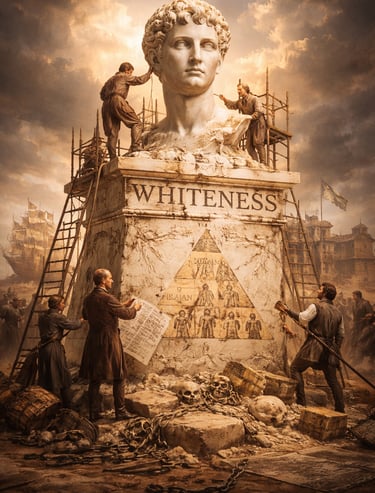
Essay 2 — “The Invention of Whiteness”
“A World Without Race”
For most of human history, the world did not have “White people” or “Black people.”
Not the way we mean it today.
If you traveled through ancient Athens or the markets of Mali, you would hear people described by their language, their lineage, their village, their kingdom, their faith.
Greek
Nubian
Persian
Ethiopian
Hebrew
Berber
Yoruba
Gaul
Skin color existed, of course — but it carried no moral meaning, no legal consequence, no social destiny.
Human difference was real.
But “race,” as a system… did not exist.
The world only discovered “race” when a particular form of power needed it.
And that is where our story begins.
SCENE 1 — The Age of Empire: A Moral Crisis
In the 1400s, European nations began pushing outward into Africa, Asia, and the Americas.
By the late 1400s and early 1500s, European powers were driven by the promise of wealth — gold and precious metals, profitable crops like sugar, vast tracts of land, and the labor needed to extract those resources — all of which translated directly into economic and geopolitical power.
They encountered societies with cities, kings, universities, agricultural systems, spiritual traditions — civilizations older and more sophisticated than many parts of Europe.
Europe wanted the resources these lands contained.
But Europe also saw itself as Christian — moral, chosen, righteous.
And that created a profound crisis of conscience:
“How do you conquer, enslave, and brutalize other human beings…
steal their land… seize their resources… exploit their labor…
and still see yourself as the ‘good guy’?”
Christian doctrine said these actions were sins.
Empire said these actions were profitable.
Europe chose profit — and then went searching for a moral justification that would allow them to keep seeing themselves as righteous while still committing atrocities.
“Our faith tells us this is wrong…
but we want the gold, the sugar, the land, and the labor.
So we need a story that makes this acceptable.”
That story became “race.”
Not discovered.
Not revealed.
Invented.
A manufactured hierarchy that placed Europeans at the top, dehumanized the people they wanted to exploit, and allowed entire nations to override their own scriptures, ethics, and consciences.
Let the colonizing begin.
SCENE 2 — 1455: The First Permission Slip
In 1455, Pope Nicholas V issued Romanus Pontifex, giving Portugal the right to invade and enslave “non-Christian” peoples of West Africa.
This wasn’t yet race — but it was the seed.
It declared some humans as extractable and conquerable.
It laid the groundwork for a worldview in which domination could be justified by difference.
But religion had limits.
People could convert.
How could you justify enslaving or brutalizing people who were now Christians like yourselves?
That wouldn’t work.
What Europe needed was something permanent.
Something you couldn’t change.
Something you inherited.
Something that followed your children, forever.
SCENE 3 — 1619: A New World, A New Problem
When enslaved Africans were brought to Virginia in 1619, they entered a colony where:
Africans
poor Europeans
and Indigenous people
all worked, traded, lived, and suffered in close proximity.
Indentured Europeans and enslaved Africans sometimes intermarried, raised children, ran away together, resisted together.
And in 1676, during Bacon’s Rebellion, poor Europeans and enslaved Africans united — burning Jamestown in protest of the elite planter class.
For the colonial elite, this alliance was terrifying.
If poor Europeans saw enslaved Africans as allies,
the entire plantation system could collapse.
A solution was needed — not economic, not religious, but psychological.
Something that would break solidarity.
Something that would divide the working class forever.
Something that cost the elite nothing,
but won them loyalty.
They found it.
SCENE 4 — The Political Bribe
In the years after Bacon’s Rebellion, colonial lawmakers crafted a new identity — an identity that had never existed before:
“White.”
And then they attached privileges to it.
Not land.
Not wealth.
Not opportunity.
But position.
“Whiteness” became a political bribe — an inducement offered by the elite to poor Europeans in exchange for their loyalty.
The bribe included:
freedom from lifelong slavery (some poor Europeans were indentured servants)
lighter punishments for the same crimes
the right to carry weapons
the right to testify in court
the right to own property
the authority to police and punish African people
and, most importantly, the guarantee that they would never be placed at the bottom of society
These privileges created a psychological elevation — a sense of being “above” someone, even while remaining desperately poor and exploited themselves.
In return, the elite received exactly what they wanted:
Loyalty from poor Europeans.
Poor Europeans stopped identifying with enslaved Africans and began identifying with wealthy landowners — the very people who were exploiting them.
(Sound familiar?)
It was an elegant, devastating strategy.
A divide-and-conquer tactic that reshaped the world — and is still going strong today.
SCENE 5 — 1691–1705: Whiteness Becomes Law
Between 1691 and 1705, Virginia passed laws that formally defined:
who counted as “White”
who counted as “Black”
who could be enslaved
who could own land
who could bear arms
who could testify in court
whose children inherited freedom
and whose children inherited enslavement
This wasn’t biology.
This was bureaucracy.
A racial caste system engineered on paper.
Historians often say that between 1660 and 1720:
“Europeans became white. Africans became Black. And Indigenous people became Red.”
Not by nature.
Not by God.
Not by DNA.
But by legislation.
SCENE 6 — 18th Century: Pseudoscience Arrives
Once race was encoded in law, European thinkers rushed to give it the appearance of science.
Carl Linnaeus — Swedish botanist, physician, zoologist, and the “father of modern taxonomy” — classified humans into four “varieties” (not races — though they became the backbone of racial ideology) and assigned personality traits and moral qualities to each.
Here were his categories:
Homo sapiens Europaeus (European)
Light-skinned
“Active, smart, inventive”
Governed by “laws”
Homo sapiens Africanus (African)
Dark-skinned
“Relaxed, lazy”
Governed by “caprice”
Homo sapiens Asiaticus (Asian)
Sallow or yellowish skin
“Severe, haughty”
Governed by “opinions”
Homo sapiens Americanus (Indigenous peoples of the Americas)
Red or copper skin
“Obstinate, contented, free”
Governed by “customs”
This was not science.
It was the European worldview disguised as classification — assigning noble traits to Europeans and infantilizing or demonizing everyone else.
These categories became one of the earliest scientific veneers used to justify:
colonization
enslavement
hierarchy
the invention of “race”
and eventually the invention of “whiteness”
Johann Blumenbach, German physician, anatomist, and naturalist — widely considered the founder of physical anthropology — invented the word Caucasian, claiming Europeans were the “most beautiful” race.
Later, Samuel Morton, American physician and natural scientist, regarded as one of the founders of American physical anthropology, measured skulls in Philadelphia and insisted Europeans had larger brains — a claim thoroughly debunked, but influential enough to shape American medicine, politics, and theology.
Again, this was not science.
It was ideology wearing a lab coat.
A justification system wrapped in Latin and measurements.
A story pretending to be nature.
SCENE 7 — 19th Century: The Expansion of Whiteness
In the 1800s, millions of Europeans immigrated to America.
Many were not considered “White” initially:
Irish Catholics
Italians
Jews
Slavs
Greeks
They were called “swarthy,” “Mongrel,” “Mediterranean,” “non-Aryan.”
Some were lynched, barred from schools, excluded from neighborhoods.
But over time, each group was absorbed into whiteness.
Not because their skin changed.
Because whiteness itself expanded.
Whiteness was never a color.
Whiteness was a club — a shifting boundary that people could sometimes enter by rejecting, distancing from, or aligning against Black people and other marginalized groups.
It was a contract, not a complexion.
A position in the hierarchy, not an “ethnicity.”
SCENE 8 — What Whiteness Really Is
Four hundred years later, the truth is unmistakable:
Whiteness is not:
ancestry
genetics
biology
or culture
Whiteness is an ideology — a political invention designed to:
secure elite power
justify stolen land
rationalize stolen labor
divide workers
control resources
maintain hierarchy
normalize dominance
keep the poor from uniting against the wealthy elites
And it was astonishingly effective.
Because the most powerful ideologies are the ones that become invisible — or are wrapped in Faith, pseudo-science, or Allegiance to Country.
CLOSING — Where the Story Goes Next
This story is not about guilt.
It is not about shame.
It is not about labeling individuals.
It is about understanding how a 400-year-old invention shaped:
economics
law
politics
spirituality
opportunity
identity
rights, freedom, and safety
And how the echoes of that invention continue to influence our world today.
In Essay 3, we will explore the next chapter of this story — how whiteness fused with Christianity, capitalism, and nation-building to form the spine of Western identity.
This is the foundation.
In the next episode, we’ll build on it.
Thank you for continuing this journey with me.
Unlearning Race
A digital space committed to exposing the lie of “race,” examining the conditioning we inherited, and reclaiming the truth of our shared humanity.
© 2026. All rights reserved.
All historical claims in these essays are grounded in reputable academic research and publicly available primary sources. You’re encouraged to explore and verify any point using reliable, nonpartisan scholarship.