Essay 3 — “The Holy Trinity of Power: Whiteness, Christianity, and the Making of a Nation”
A deep, fact-based exploration of how whiteness fused with Christianity, economics, and national identity to shape America—revealing how theology was rewritten, laws were engineered, and an entire worldview was constructed to justify inequality and protect power.
1/30/20268 min read
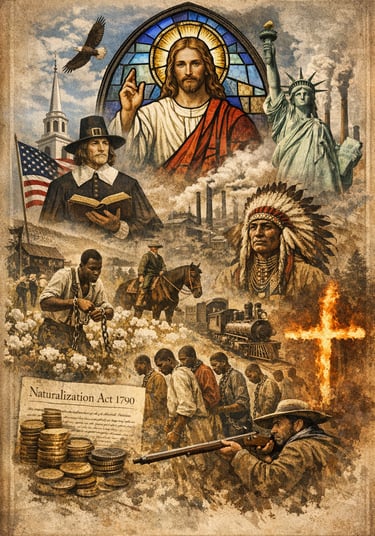
Essay 3 — “The Holy Trinity of Power: Whiteness, Christianity, and the Making of a Nation”
OPENING — The Next Layer of the Story
By the end of Essay 2, whiteness had become law—written into Virginia statutes, encoded into labor systems, and cemented into a new racial hierarchy. But laws don’t sustain themselves. An ideology this durable needs something deeper than enforcement. It needs meaning. It needs morality. It needs a story people can believe in.
Whiteness survived because it fused itself to the three most powerful forces in the emerging Western world:
religion
economics
national identity
This is how whiteness became not just a category—
but a worldview.
SCENE 1 — When God Became White
Jesus was born in Bethlehem, in the region of Judea—part of the ancient Near Eastern world historically known as Palestine. He was a brown-skinned Middle Eastern Jew. His mother was brown. His disciples were brown. His community was brown.
The earliest Christian art—especially from Egypt, Ethiopia, Palestine, and across North Africa—reflected that reality:
darker or brown skin tones
tightly curled or textured hair
Middle Eastern and African features
But as Christianity took root in Europe, something shifted. With the rise of the Renaissance, European artists began repainting the holy family using European faces, European landscapes, and European aesthetics:
Jesus became pale, light-haired, soft-featured
Mary became a European mother
biblical scenes began to resemble European countryside
This wasn’t historical fidelity. It was cultural whitewashing—Europe overwriting Middle Eastern and African faces with its own, transforming the image of the sacred into a reflection of European power.
Over centuries, the sacred was repainted into the image of Europe…
and Europe became the image of the sacred.
SCENE 2 — The Forgotten Images: Black Madonnas and the Original Faces of Christianity
Yet quietly, another tradition endured. Across Europe—in cathedrals, monasteries, and mountain shrines—there are more than five hundred Black Madonnas: dark-skinned Marys, dark-skinned infant Jesuses, icons with African features, and statues polished black by centuries of touch and prayer.
Some reside in the Vatican’s own collections. Others became centerpieces of national devotion:
Our Lady of Montserrat (Spain)
Our Lady of Czestochowa (Poland)
The Black Madonna of Moulins (France)
These images predate modern racial language and preserve an older, more global imagination of the holy. But they never became the dominant image of Christianity—not because they lacked devotion, but because Renaissance Europe had the machinery of dominance: the printing presses, the missionaries, the money, and the political power.
So while Black Madonnas watched over local pilgrimages and sanctuaries, White Jesus became the export. White Jesus became the standard. White Jesus became the empire.
A Black Madonna belonged to a community.
A white Christ belonged to the world.
SCENE 3 — “A City Upon a Hill”: The Divine Mandate for Expansion
In 1630, Puritan leader John Winthrop told his fellow settlers their colony would be “a city upon a hill.” He wasn’t describing immigration. He was describing destiny.
The Puritans believed themselves chosen—ordained by God to bring Christian civilization to a land they imagined as empty, unused, or waiting. That theological framing provided moral cover for what came next:
Indigenous displacement
land seizure
forced conversion
cultural destruction
and eventually, what many historians describe as genocide
Whiteness gained not just political power—
but sacred power.
Christianity didn’t just bless the settlers.
It justified the settlement.
SCENE 4 — The Weaponization of Scripture
In the 1700s and 1800s, American clergy twisted the biblical “Curse of Ham” into a racial doctrine—claiming Africans were destined to serve.
The story comes from Genesis 9:20–27. After the flood, Noah becomes drunk and lies uncovered. His son Ham sees him and tells his brothers, Shem and Japheth. The brothers respectfully cover Noah without looking. When Noah wakes up, he curses not Ham—but Ham’s son Canaan:
“Cursed be Canaan; the lowest of slaves will he be to his brothers.”
— Genesis 9:25
That’s it. That is the entire biblical account. The text says nothing about skin color. It says nothing about Africa. It justifies nothing.
The racialized “Curse of Ham” interpretation was invented centuries later and then expanded and exploited over time—first by medieval theologians, later by European colonial powers, and fully weaponized in the 17th–19th centuries to legitimize enslavement.
This false teaching claimed that:
Ham was made Black
his descendants were Black Africans
God condemned Black people to servitude
And once that lie entered pulpits, it did what propaganda is designed to do:
slavery became God’s will
hierarchy became divine order
whiteness became righteousness
Blackness became sin
resistance became rebellion against God
This wasn’t theology.
It was economics dressed as scripture—religious language engineered to protect profit.
SCENE 5 — How Economics Warped Christian Theology to Justify Enslavement
In the early 17th century, English colonies—especially Virginia and Barbados—were exploding with demand for labor to fuel the production of tobacco, sugar, indigo, and later cotton. Indentured European labor was expensive, temporary, disease-prone, and protected by English common law. Colonial elites wanted something else: a labor system that was permanent, inheritable, stripped of rights, and defensible as “moral.”
That economic pressure is what reshaped theology.
The barrier: Christian doctrine had long restricted enslavement of Christians
For centuries, Christian tradition carried a clear norm: a Christian may not enslave another Christian.
That norm appears repeatedly across eras of church authority:
St. Gregory of Nyssa (AD 379) condemned slavery as incompatible with the nature of human freedom under God:
“You condemn a person to slavery, whose nature is free, and who belongs to God alone.” (Homily on Ecclesiastes 4:7)
Gratian’s Decretum (c. 1140), foundational medieval canon law in the Corpus Juris Canonici, included provisions forbidding Christians from enslaving Christians and treating conversion as grounds for freedom.
Pope Eugene IV, Sicut Dudum (1435) threatened excommunication for those who enslaved newly baptized Christians in the Canary Islands, explicitly reinforcing: conversion → freedom.
Pope Paul III, Sublimis Deus (1537) condemned the enslavement of Indigenous peoples and affirmed they were to enjoy liberty and property, rejecting enslavement as legitimate.
This doctrine created a crisis once Africans began converting to Christianity. If conversion implied freedom, slavery became unstable—not just morally, but legally and institutionally within Christian frameworks.
The colonial “solution”: rewrite the rules
In 1667, Virginia passed a law to override the “Christian-equals-free” logic:
“Baptism does not alter the condition of the person as to his bondage or freedom.”
That law only makes sense because the expectation it contradicted was already present: that Christians should not remain enslaved. So rather than allow Christian doctrine to disrupt the labor system, colonial elites made the labor system immune to Christian doctrine.
This is the pivot point: economics forced religion to bend—and theology became the camouflage for exploitation.
The workaround becomes an industry: pro-slavery clergy and the Curse of Ham
As slavery expanded, clergy in the slaveholding South did not merely “tolerate” it. Many defended it as biblically sanctioned, natural, and ordained—creating a framework that could soothe consciences and discipline the enslaved.
Key figures include:
Rev. Richard Furman (South Carolina, 1822) — issued the “Furman Letter,” defending slavery as biblical and ordained.
Rev. Thornton Stringfellow (Virginia, 1841) — published “A Brief Examination of Scripture Testimony on the Institution of Slavery,” using Genesis 9 to argue slavery was divinely sanctioned.
Charles Colcock Jones (Georgia, 1830s) — a major pro-slavery missionary who instructed enslavers on how to use Christianity to produce compliance.
Bishop Stephen Elliott (Georgia, 1800s) — a leading Southern Episcopal bishop who preached that slavery was assigned by God.
These were not fringe outliers. Their writing shaped sermons, policy, slave codes, and the religious consciousness of millions.
The cotton engine locks theology in place (1793 → 1860)
In 1793, Eli Whitney invented the cotton gin, turning cotton into an economic super-engine. Cotton production exploded from 5 million pounds (1793) to over 2 billion pounds (1860)—and with it, the value of enslaved labor.
By 1860, enslaved people represented the single largest financial asset in the United States—worth about $3 billion (1860 dollars), more than all the nation’s railroads, banks, and factories combined.
So the question was no longer “Is slavery moral?”
The real question became: “How do we keep an economy like this from collapsing under its own moral contradiction?”
The answer was theology.
Ministers preached obedience, submission, and “divine order.” Plantation owners needed enslaved people convinced that rebellion was sin and that justice was deferred to heaven. And clergy—often funded by the very elites who profited—supplied the religious language.
A vivid example: Rev. George Whitefield (1700s)—celebrated evangelist, revival leader—personally lobbied to expand slavery in Georgia and built his orphanage using enslaved labor.
This wasn’t fringe.
This was American Christianity in action.
Church institutions formalize the split
By the mid-1800s, major American denominations fractured rather than reject slavery:
Methodists and Presbyterians split (1844–45) over slavery.
The Southern Baptist Convention (1845) formed explicitly amid disputes over whether enslavers could serve as missionaries.
In seminaries during 1820–1860, students were taught pro-slavery theology using carefully selected texts—Genesis 9, Abraham and Hagar, and Pauline household codes like “servants obey your masters.”
This was not accidental.
It was a coordinated theological system designed to protect an economic system.
SCENE 6 — Capitalism and the Price of Human Lives
By 1860, enslaved people were not simply laborers; they were capital. Human beings were assets. They were inherited wealth. They were collateral for loans. They were counted, priced, mortgaged, insured, and traded.
And as slavery grew more profitable, the ideology of whiteness grew more sacred.
Because the more money slavery generated, the more intensely the nation needed a story that could make the exploitation feel righteous—especially to the people who claimed to be Christian.
Slavery ended. But the hierarchy it built adapted. It reappeared through new systems that preserved extraction while shifting the language:
sharecropping
convict leasing
exclusion of Black workers from parts of the New Deal safety net, including Social Security
Jim Crow
redlining
discriminatory lending
segregated education
Whiteness remained the passport to opportunity.
SCENE 7 — The Nation Declares Itself White
In 1790, the U.S. Naturalization Act limited citizenship to:
“free white persons… of good character.”
Not Africans. Not Indigenous peoples. Not Asians. Not many Europeans outside the Anglo-Protestant mold.
Whiteness became the requirement for belonging, the foundation of citizenship, and the default definition of “American.” America did not simply become a democracy. It became a white republic, spiritualized through Christianity and fortified by capitalism.
Naturalization eligibility was expanded to include Black peoples in 1870. This act was not amended to remove "whiteness" as a factor in naturalization eligibility for everyone until 1952 by the McCarran-Walter Act.
SCENE 8 — The Psychology: Why People Believed It
Whiteness endured not because it was logical, but because it was useful. It offered psychological rewards that felt like salvation—social salvation, psychological salvation.
It offered:
Moral innocence — “You are virtuous because God made you superior.”
Economic hope — “You deserve opportunity; if you struggle, it’s because others want what you have.”
National identity — “You are the true American; others are perpetual outsiders.”
Belonging — whiteness as the ticket into the moral community.
And because it was accepted, codified, sanctified, and taught, it was handed down as “divine birthright”—not only the claim of inherent superiority, but the paired doctrine of inherent, divinely ordained inferiority for everyone else.
SCENE 9 — The Bribe That Became a Cage
But whiteness didn’t only harm the oppressed. It harmed the people who embraced it. It demanded emotional numbness, fear of the “Other,” obedience to hierarchy, distrust of difference, suppression of empathy, loyalty to elites, and a shrinking moral imagination.
Whiteness required its believers to trade humanity for status and justice for comfort. It promised elevation, but delivered confinement.
Because the bribe offered to poor Europeans—the original “you’ll always be above someone”—was one of history’s earliest forms of trickle-down economics:
“Give us your loyalty.
Don’t question our power.
Align with us, not with them.
And you will always outrank non-white people.”
Not real wealth. Not real mobility. Not real security. Just psychological position—fragile, symbolic, manufactured.
They were told: “Your life might improve someday. And if it doesn’t, blame the people beneath you demanding equality.” And if all else failed: “Your reward will come in heaven.”
It was a masterstroke of social engineering: keep poor whites loyal, keep them afraid of equality, keep them blaming downward instead of upward, and keep them defending a system that did not materially benefit them.
Whiteness was sold as a ladder.
But for most, it functioned as a leash.
CLOSING — The Architecture of an Ideology
This is how whiteness fused religious myth, economic power, and national identity into an unshakeable worldview. It’s why challenges to the hierarchy still feel—for some—like attacks on their faith, their place in the world, their family story, their safety, their understanding of America, and their very identity.
Because when an ideology is codified, sanctified, normalized, and inherited, it begins to feel like truth—even when it isn’t.
This is the foundation.
In Episode 4, we explore the psychology beneath it: the insecurity, fear, and fragility that whiteness works so hard to hide.
Thank you for continuing this journey with me.
Unlearning Race
A digital space committed to exposing the lie of “race,” examining the conditioning we inherited, and reclaiming the truth of our shared humanity.
© 2026. All rights reserved.
All historical claims in these essays are grounded in reputable academic research and publicly available primary sources. You’re encouraged to explore and verify any point using reliable, nonpartisan scholarship.