Essay 4: Fragile White Identity: The Insecurity Beneath the Ideology
Whiteness has always projected confidence—an identity that claims authority, entitlement, and moral certainty. But beneath the surface of that projection lives something more vulnerable: a deep, persistent insecurity. An identity built not on biology or culture, but on comparison, requires constant reinforcement. And anything that requires constant reinforcement is fragile. Fragile white identity is not about individuals being sensitive. It is about a system that depends on emotional volatility to keep itself alive. Because if whiteness is an invention, then its survival hinges on how fiercely people defend it. This episode is about that defense—how it was made, how it shapes behavior, and why it continues to produce fear, backlash, and violence across American history.
2/7/20266 min read
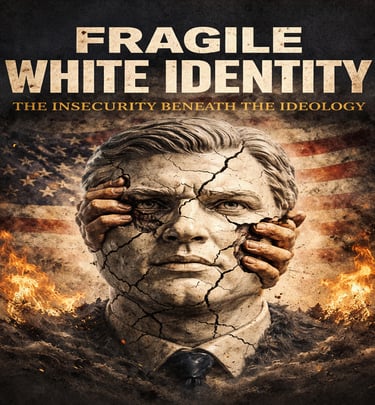

EPISODE 4 — Fragile White Identity: The Insecurity Beneath the Ideology
Whiteness has always projected confidence—an identity that claims authority, entitlement, and moral certainty. But beneath the surface of that projection lives something more vulnerable: a deep, persistent insecurity. An identity built not on biology or culture, but on comparison, requires constant reinforcement. And anything that requires constant reinforcement is fragile.
Fragile white identity is not about individuals being sensitive. It is about a system that depends on emotional volatility to keep itself alive. Because if whiteness is an invention, then its survival hinges on how fiercely people defend it.
This episode is about that defense—how it was made, how it shapes behavior, and why it continues to produce fear, backlash, and violence across American history.
The Psychology of an Insecure Identity
At its core, whiteness is a zero-sum identity. It requires the belief that worth is comparative and hierarchical. For an identity like that to persist, its followers must continually guard against the possibility that others may rise or that the hierarchy may flatten.
Psychologists call this status threat: the fear that one’s social position is slipping, even when nothing material has changed.
Research shows that when white-identifying Americans feel threatened—economically, culturally, or demographically—their support for authoritarian leaders increases, their empathy toward out-groups decreases, and their tolerance for violence rises. These reactions are not personal quirks. They are predictable expressions of an identity constructed on fear of loss.
Fragile identities respond to equality as danger.
Fragile identities interpret demographic change as invasion.
Fragile identities see justice not as fairness but as redistribution of something they believe belongs to them.
This insecurity is not accidental. It was cultivated.
Historical Example 1: Wilmington, 1898 — When Democracy Felt Like a Threat
One of the clearest examples of fragile white identity erupting into violence is the 1898 Wilmington Coup, the only successful coup d’état in American history.
Wilmington, North Carolina, had a thriving Black middle class—business owners, skilled laborers, journalists, and elected officials. It was a functioning multiracial democracy.
For white supremacists, the existence of Black political power was intolerable.
Newspapers warned that Black success would “overrun” white society. Politicians claimed Black voting threatened “civilization.” These fears were not grounded in fact—they were emotional responses to a perceived loss of status.
On November 10, 1898, white supremacist militias attacked Wilmington:
They murdered Black residents in the streets.
They burned the Black-owned newspaper.
They forced legally elected Black and white officials to resign at gunpoint.
They installed white supremacist leaders in their place.
This was not a fight for economic survival.
It was the panic of an identity that could not tolerate equality.
Historical Example 2: Tulsa, 1921 — When Prosperity Triggered Fear
In 1921, the Greenwood District of Tulsa—known as Black Wall Street—was one of the wealthiest Black communities in the United States. It had Black-owned banks, hotels, doctors' offices, luxury shops, and airplanes. It was prosperous, self-sustaining, and confident.
For fragile white identity, this was a direct threat.
After a false rumor about an assault, white mobs—supported by local authorities—launched one of the most destructive racial massacres in American history.
For 18 hours:
White mobs burned 35 square blocks of businesses and homes.
The Oklahoma National Guard detained thousands of Black residents.
Eyewitnesses reported private planes dropping incendiary materials from above.
Historians estimate 300 Black people were killed, though exact numbers remain unknown.
The trigger was not crime.
Not danger.
It was Black prosperity—proof that equality was possible.
Nothing threatens a fragile identity more than evidence that its hierarchy is illegitimate.
Historical Example 3: Rosewood, 1923 — Fragility as Fury
Just two years later, in Rosewood, Florida, a white woman’s accusation—never substantiated—ignited another white mob. What followed was systematic destruction:
Black homes were burned.
Residents were hunted through the swamps.
Entire families fled and never returned.
Rosewood was wiped off the map.
Fragile white identity interprets unproven allegations as moral catastrophe—but only when the accused are Black.
These massacres were not random explosions of rage.
They were expressions of insecurity—moments when white status felt threatened, and violence was used to restore the psychological order.
Historical Example 4: Anti-Asian Violence — When Fear Masqueraded as Protection
Fragile white identity has never been limited to Black–white dynamics.
In 1871, in Los Angeles, a mob of nearly 500 white and Latino men murdered at least 18 Chinese immigrants in one night. The victims were lynched, shot, or mutilated. The incident was triggered by the fabricated fear that Chinese immigrants were “taking jobs” and “polluting the city”—the same rhetoric used today.
In 1942, the U.S. government imprisoned 120,000 Japanese Americans, two-thirds of whom were U.S. citizens, not because of evidence of espionage but because white Americans felt afraid. Entire families lost businesses, property, and dignity—based on an imagined threat.
What makes the incarceration of Japanese Americans during World War II so revealing is not only that it happened —but that it happened selectively.
If the danger had truly been “enemy nations,” the United States would have treated all Axis-nation immigrants the same.
It did not.
Between 1942 and 1945, the federal government forcibly removed and incarcerated 120,000 people of Japanese descent — two-thirds of them U.S. citizens — including infants, the elderly, and entire families. Their businesses were seized, their homes confiscated, their savings lost. Mass punishment. No trials. No charges.
Yet at that same moment:
Over 5 million Italian Americans,
and more than 1 million German Americans,
lived openly in the United States.
We were at war with Italy and Germany.
We were fighting their soldiers, their governments, their fascist movements.
And still, the U.S. government did not round up Italian or German communities, did not incarcerate their children, did not seize their property, and did not force them into desert camps under armed guard.
A small number of German and Italian nationals — mostly non-citizens — were briefly detained under individual hearings.
But there was no mass relocation.
No family imprisonment.
No wholesale destruction of livelihoods.
The difference was not national security.
It was racial classification.
German and Italian immigrants, despite earlier waves of discrimination, had been absorbed into the expanding category of whiteness. Whiteness granted them:
the presumption of loyalty,
the benefit of individualized judgment,
the right to due process,
and the assumption that they were “really” American.
Japanese Americans were denied all of those protections because they were not seen as an “enemy nationality.”
They were imagined as an enemy race — a biologically suspicious population, an undifferentiated mass whose very existence was treated as a security threat.
In 1983, the federal commission investigating the internment concluded that the camps were the product of:
“race prejudice, war hysteria, and a failure of political leadership.”
Not evidence.
Not espionage.
Not national security.
This is fragile white identity made visible in public policy:
the speed at which a society will sacrifice the freedoms of those it sees as “Other” while protecting those safely inside the borders of whiteness.
Fragile identities require enemies.
When none exist, they are invented.
Historical Example 5: The Boston Busing Riots — When Children Triggered Panic
In 1974, Boston erupted in violence when federal courts ordered the integration of public schools through busing.
White parents—many poor and working class—attacked school buses carrying Black children with rocks, bricks, and bottles.
The image of a Black teenager, Theodore Landsmark, being attacked with an American flagpole became a national symbol of white civic rage.
These parents weren’t elites.
They weren’t landowners.
They weren’t plantation heirs.
They were ordinary white-identifying Americans whose sense of social position felt threatened by Black children riding a bus.
Fragile identity sees even a shared classroom as danger.
The Modern Expression of Fragility
Fragile white identity didn’t vanish with Jim Crow.
It simply updated its vocabulary.
Today it appears as:
demographic panic (“They are replacing us”)
book bans targeting racial history
attacks on DEI and “wokeness”
fear-based rhetoric around immigration
rising Christian nationalism
backlash against transgender rights
conspiracies claiming that equality is “Marxism,” “indoctrination,” or “erasure”
political messaging that promises safety from imagined threats
Research after 2016 showed that white Americans who felt cultural status threat were significantly more likely to support nationalist, authoritarian, or conspiratorial movements, regardless of economic position.
January 6 was not an anomaly.
It was a contemporary expression of fragile identity—people who believed the country was “being stolen” from them storming the Capitol to stop a process they thought diminished their place in the hierarchy.
The psychology is consistent from Wilmington to today:
When identity feels unstable, violence begins to feel righteous.
The Emotional Cost to Believers
Fragile white identity does not just harm people of color.
It harms the people who cling to it.
It demands:
constant vigilance
suspicion of outsiders
fear of social change
obedience to political strongmen
moral numbness
hostility toward difference
loyalty to elites who exploit them
Studies show that white Americans who anchor their self-worth in whiteness experience:
higher fear responses
higher perceived personal victimization
greater support for punitive policies
deeper resistance to empathy
higher rates of depression, addiction, and social isolation in racially homogeneous communities
Fragility shrinks the emotional world.
It restricts curiosity.
It constricts humanity.
It prevents genuine connection across difference.
Perhaps the deepest cost is this:
When you are trained to fear equality,
you will never notice when the powerful treat you unequally.
Fragile identity protects the hierarchy—
not the individuals inside it.
Closing
Fragile white identity was engineered in the 1600s,
weaponized in the 1800s,
inflamed in the 1900s,
and digitized in the 2000s.
It is the psychological engine behind backlash,
the emotional script behind racial violence,
and the reason equality continues to feel dangerous to those taught that their worth depends on comparison.
Whiteness presents itself as strong.
But its strength has always depended on insecurity—
a fear that the hierarchy is artificial
and could collapse
if ever truly questioned.
In Episode Five, we examine what happens when this fragile identity feels cornered,
and why backlash, violence, and extremism are not aberrations—
but the predictable survival strategies of a system afraid of its own undoing.
Unlearning Race
A digital space committed to exposing the lie of “race,” examining the conditioning we inherited, and reclaiming the truth of our shared humanity.
© 2026. All rights reserved.
All historical claims in these essays are grounded in reputable academic research and publicly available primary sources. You’re encouraged to explore and verify any point using reliable, nonpartisan scholarship.