Essay 5: “When the Myth is Threatened: The Backlash Engine of Whiteness”
For four centuries, the ideology of whiteness has survived by convincing its believers that equality is danger and hierarchy is safety. But the clearest measure of its fragility is what happens the moment its supremacy is challenged. This essay is about the backlash when "whiteness" feels threatened.
2/7/20265 min read
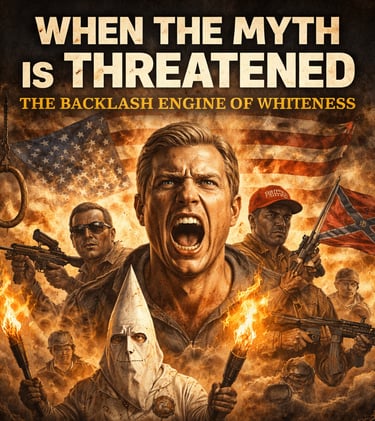
EPISODE 5 — “When the Myth is Threatened: The Backlash Engine of Whiteness”
For four centuries, the ideology of whiteness has survived by convincing its believers that equality is danger and hierarchy is safety.
But the clearest measure of its fragility is what happens the moment its supremacy is challenged.
In American history, progress has never moved in a straight line forward.
It has moved in a cycle:
A breakthrough.
A reaction.
A backlash.
A rewiring of the hierarchy.
And the backlash is always strongest when the myth of white superiority is closest to collapse.
This episode is about that reflex —
How insecurity fuels retaliation,
How fear becomes violence,
And how the system restores itself through force, law, and memory.
SCENE 1 — The First Test of the Myth: When Freedom Came
In 1873, eight years after the Civil War, Black men in Colfax, Louisiana attempted to protect their newly won political rights. When white paramilitary groups arrived to overturn the election results, a confrontation erupted at the courthouse.
When it ended, more than 150 Black men were murdered, many after surrendering.
The message was unmistakable:
“Your freedom may be legal.
But it cannot challenge our hierarchy.”
The federal government prosecuted three of the killers.
The Supreme Court overturned the convictions in United States v. Cruikshank (1876), ruling the federal government had little power to protect Black citizens from white violence.
The backlash became law.
And white insecurity became precedent.
SCENE 2 — 1919: The Year the Fear Turned National
In the summer of 1919, known as Red Summer, Black veterans returned from World War I expecting the dignity they had earned abroad.
Instead, they encountered an America terrified by the idea of Black men carrying themselves with confidence.
White mobs attacked Black communities in more than 30 cities, including Chicago, Washington D.C., Knoxville, Omaha, and Elaine, Arkansas.
In Elaine alone, an estimated 200+ Black men, women, and children were massacred after Black sharecroppers attempted to organize for fair wages.
The veterans who defended their neighborhoods were called “rioters.”
The mobs who killed them were called “patriots.”
Sound familiar?
Backlash always claims to be protecting the nation.
In truth, it is protecting the hierarchy.
SCENE 3 — The Ocoee Massacre: “You Will Not Vote.”
On Election Day 1920, in Ocoee, Florida, a Black farmer named Moses Norman attempted to vote.
White poll workers turned him away.
A mob formed.
By nightfall, white residents had burned the entire Black community, killing an estimated 30–60 people and driving out every surviving family.
Ocoee became an all-white town for decades.
The official reason given:
“Restoring order.”
The real reason:
The idea of Black political power was intolerable.
Whiteness reacts violently when its political dominance is threatened.
The threat doesn’t need to be real — only imagined.
SCENE 4 — Little Rock: The Schoolhouse Door
In 1957, three years after the Brown v. Board of Education decision, nine Black teenagers walked toward Central High School in Little Rock.
They were met by hundreds of white adults screaming, spitting, threatening to kill them.
Local police stepped aside.
The governor sent the National Guard — not to protect the students, but to block their entry.
The federal government intervened only when the crisis embarrassed the nation globally.
President Eisenhower sent the 101st Airborne to escort the children through the doors.
But even that didn’t stop the backlash.
White parents pulled their children from the school.
They created private academies to avoid integration.
The next year, Little Rock closed every public high school rather than allow Black children inside.
The hierarchy must survive, even if the city destroys its own future to protect it.
SCENE 5 — When Housing Equality Became the New Battlefront
By the 1960s, Black Americans were pressing into northern cities, pushing into professions, earning higher incomes, buying homes.
Progress triggered backlash.
After the Fair Housing Act of 1968, white neighborhoods across the country erupted in panic:
“For Sale” signs multiplied.
Real estate agents stoked fear with talk of “neighborhood decline.”
Banks engaged in redlining to corral Black upward mobility.
Cities enacted zoning restrictions to preserve segregation by class — a proxy for race.
In Detroit, Chicago, Cleveland, and Philadelphia, white residents attacked Black families attempting to move into previously white-only neighborhoods.
Bricks through windows.
Cross burnings on lawns.
Bombs in mailboxes.
Prosperity for Black families felt like dispossession to white residents conditioned to believe that “their” neighborhoods were a birthright.
Backlash is not superstition.
It is identity maintenance.
SCENE 6 — When Asian Prosperity Became a Target
In 1982, in Detroit, two white autoworkers beat Vincent Chin, a Chinese American engineer, to death with a baseball bat because they blamed “the Japanese” for auto industry layoffs.
Detroit’s largest automakers were restructuring and outsourcing.
White workers were losing jobs.
Corporate decisions created the pain.
White executives — protected by the very hierarchy they preached — cut costs, moved factories overseas, and increased profits at the expense of the very white workers whose loyalty the system depended on.
But this is one of the oldest tricks of whiteness:
Elites harm poor and working-class whites for profit,
Then teach them to blame people of color for the suffering elites created.
A closed factory becomes “the fault of immigrants.”
A lost job becomes “the fault of Japan.”
Economic anxiety becomes a racial story instead of a corporate one.
Whiteness protects elites by redirecting white anger downward instead of upward.
It isn’t just a hierarchy —
It is a shield.
But the backlash moved sideways — toward an Asian face.
And Vincent Chin paid for that misdirection with his life.
Vincent Chin wasn’t Japanese.
He wasn’t an economic threat.
He wasn’t responsible for industry decline.
But the mythology of whiteness needed someone to blame whom it could safely define as “not us.”
His killers received no prison time.
Backlash always has official permission.
SCENE 7 — 2015–2020: The Most Measured Backlash in Modern Political Science
Demographers predicted in the early 2000s that the United States would become majority non-white sometime around 2045.
This prediction — not an event, not a law, not a crisis — triggered measurable psychological reactions among white-identifying Americans.
Political scientists found that when white Americans were reminded of demographic change:
Support for authoritarian policies increased
Hostility toward immigration rose
Sympathy for punitive policing increased
Trust in democracy decreased
Respondents were more likely to agree that “America is losing its culture”
Many began to self-identify as “white” for the first time in their lives
These were replicated findings across multiple peer-reviewed studies.
A shift in numbers — not policy — activated the same internal alarm system that had sparked violence for centuries.
When the myth of dominance feels threatened, belief hardens and backlash follows.
SCENE 8 — 2020: The Multiracial Uprising and the Legislative Whiplash
When millions of Americans — across lines of age, class, and culture — protested after the murder of George Floyd in 2020, it was the largest civil rights demonstration in U.S. history.
For a moment, it looked like a turning point.
But the backlash arrived quickly.
Within two years, over 30 states introduced or passed laws restricting:
teaching about racism
discussing structural inequality
DEI programs
inclusive curricula
LGBTQ+ visibility
voting access
Under the banner of “protecting children,” “saving the republic,” or “fighting indoctrination,” lawmakers resurrected old anxieties:
“We’re losing our country.”
“They are taking over.”
“We must take our nation back.”
It was the same reflex that burned Greenwood.
The same reflex that closed schools in Little Rock.
The same reflex that turned Ocoee into a whites-only town.
The ideology changes its vocabulary.
The fear never changes its shape.
CLOSING — The Backlash Pattern Is the Blueprint
Backward-looking nostalgia.
Invented enemies.
Moral panic.
Punitive politics.
Violence.
Legal restriction.
Erasure.
This is the cycle that has accompanied every step toward equality in American history.
Not because white-identifying Americans are uniquely violent or cruel —
But because the ideology of whiteness is uniquely fragile,
And fragility reacts to threat with force.
When equality approaches, whiteness does not ask,
“How do we grow?”
It asks,
“How do we restore the hierarchy?”
Backlash is not the failure of whiteness.
It is its operating system.
In Episode 6, we examine how that operating system moved from violence into institutions — And how laws, courts, policing, economics, and memory itself have been used to protect an identity built on fear.
Unlearning Race
A digital space committed to exposing the lie of “race,” examining the conditioning we inherited, and reclaiming the truth of our shared humanity.
© 2026. All rights reserved.
All historical claims in these essays are grounded in reputable academic research and publicly available primary sources. You’re encouraged to explore and verify any point using reliable, nonpartisan scholarship.